
Kore Material Intelligence
Sense for the factory floor.
Kore Material Intelligence is the industrial arm of the Kore platform: one Seed platform reading machines, processes, and materials, iron and steel included. It enters through evidence, not promises, starting with a fixed-price audit of records the plant already has.
Concept stage · Pre-prototype · Shadow mode first, always
The industrial Seeds
Three senses a factory does not have yet.
Each sensor below is a concept design target, not a product. Their job is narrow: hear the machine, read the material, and watch the process chemistry, then say what changed and how sure the system is.
Resonance Signature Array
Acoustic emission and high-frequency vibration sensing for cracks, friction, cavitation, impacts, tool wear, and instability. A signature change is an indicator to investigate, not proof of failure, and it is reported that way.
Microstructure & Stress Probe
Electromagnetic and magnetic non-destructive evaluation, eddy current and Barkhausen-class signals, aimed at stress, case depth, hardness variation, and defect risk near critical areas. Signals depend on alloy, geometry, and temperature, so calibration is part of the design.
Process Chemistry & Drift Sentinel
Optical, electrochemical, and gas sensing for coolant, lubricant, and process-bath drift, tied to temperature, dosing, and contamination events. Chemistry sensing is highly process-specific, so every deployment starts with feasibility, not a catalog claim.
The factory loop
Sense. Interpret. Verify. Learn.
Material Intelligence runs the same staged loop as the rest of Kore, with one rule factories can trust: control is earned last, never assumed first.
Sense
Capture the signal with its timestamp, source, and operating context attached.
Interpret
Compare against the plant baseline and report in plain language, with uncertainty preserved.
Control
Only with explicit authorization, only inside validated limits, and only after shadow-mode evidence.
Verify
Check whether the approved action actually improved the result. Interventions that do not help are not repeated.
Learn
Every confirmed event joins the signal library, so the next plant starts smarter than the last.
Read-only, until proven
Every new deployment begins in shadow mode: Kore observes and reports while writing nothing to live machine control. Operators stay in charge, and potential false alarms cost nothing but attention.
The Reaction Studio
Every alarm becomes a card an engineer can judge.
When something changes on a line, Material Intelligence is designed to produce a single timestamped event card instead of a bare alarm. The card is the product: evidence first, recommendation second.
- What changed
- The signal that moved, in plain language
- Who saw it
- The sensors that agreed, and any that did not
- Confidence
- A stated level with its uncertainty, never a bare yes
- Candidate actions
- Options for engineering review, not commands
- Outcome
- Whether the approved action improved the result
The front door
Start with a Process Intelligence Audit.
A fixed-price review of records the plant already keeps: downtime logs, scrap and rework records, temperature histories, vibration readings, maintenance records, and quality reports. No new hardware, no line changes, no obligation past the report.
What the audit returns
- Baseline
- Where the process actually runs today
- Patterns
- What the records show, separated from interpretation
- Priorities
- The few investigations worth doing first
- Measurement plan
- What to sense, where, and what proof would look like
Illustrative test pricing of $500 to $1,500 per audit is a proposed range being validated with plant operators. It is not a rate card, and it changes only when the evidence says it should.
The hardware line
Same seed, steel skin.
Material Intelligence deployments ride on Kore Steel: the same Seed platform in brushed stainless steel housings, built for wash-down rooms, plant floors, hospital corridors, and fields. Enclosure ratings are design targets only, and nothing in the line is certified today. Steel also carries the facility, grounds, and field audits for hospitals, private grounds operators, and farmland.
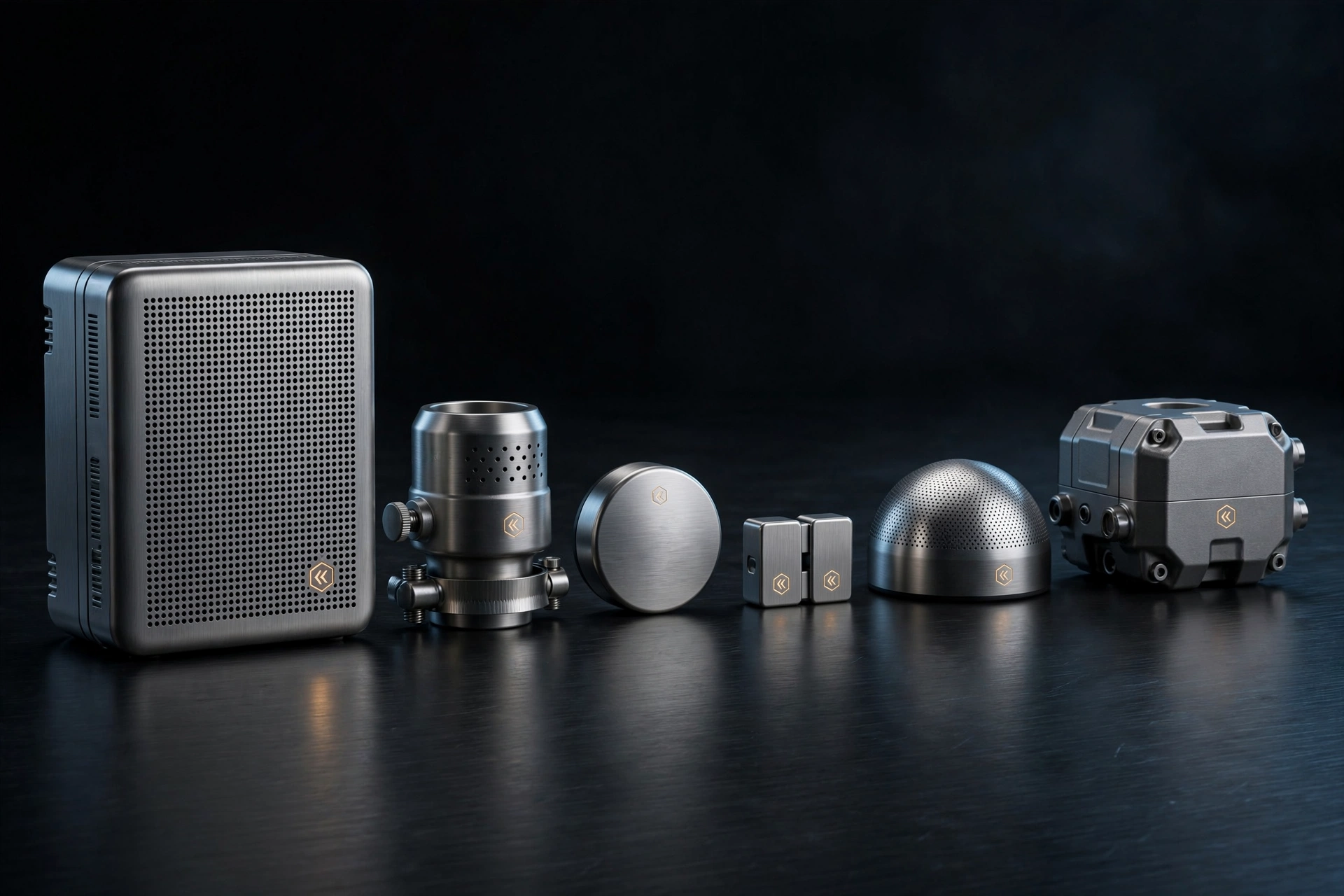 Concept
How engagements grow
Evidence first. Each step earns the next.
Material Intelligence is a proposed business inside Kore, and none of this is current revenue. The sequence below is how an engagement is designed to grow when the proof supports it.
Audit
The fixed-price review of existing records. If the records show nothing worth chasing, the report says so and the engagement ends honestly.
Paid pilot
A narrow sensing pilot on one line or one material stream, compared against the baseline the audit established.
Monitoring
Ongoing monitoring and reporting, event cards included, priced per line or per site.
Integration
Signals wired into the systems the plant already runs, with the safeguards and oversight agreed in writing.
Control, maybe
Only after validation, safeguards, and human oversight are proven in shadow mode, and only with authorization.
Plants teach homes
Industrial signal libraries strengthen the whole Kore platform, and the factory floor is where the hardest sensing problems get solved first.